Made in Korea Episodes 3-4 were released on December 31, 2025, as part of Disney Plus’s original Korean series lineup.
Immediately after release, the drama climbed to No. 3 in the global Disney Plus TV rankings, drawing especially strong reactions across Asia. The response appears driven by its noir-film sensibility and the sheer gravity of the Hyun Bin–Jung Woo-sung pairing.
Episodes 3 and 4 fully lean into the power structures of the 1970s military regime, exposing the ambitions of those who claw their way upward through its cracks. As the pace accelerates, the narrative axis becomes far clearer.
Made in Korea Episodes 3-4 mark the point where the series’ power dynamics fully lock into place.
1. Made in Korea Episodes 3-4: The Rise of Bae Geum-ji
Episode 3 belongs unmistakably to Bae Geum-ji (Cho Yeo-jeong).
In Made in Korea Episodes 3-4, her character becomes the clearest symbol of how disposable truth is under power.
A former high-class madam, she is a woman entangled with countless powerful figures. The mere rumor of her “notebook” is enough to place both the Korean Central Intelligence Agency and the Blue House on edge.
What’s fascinating is that the notebook’s existence matters less than the possibility that it exists. Geum-ji understands this perfectly. She chooses to remain in Korea, pretending to pursue business and an ordinary life, all while stepping directly into the center of the game.
But this era offers no mercy.
Geum-ji is neither protected nor spared. Used and discarded, she is quietly eliminated. Her final scene—hands trembling as she smokes her last cigarette—stands as one of the most haunting images of the episode. It is a moment that makes the phrase “this is Cho Yeo-jeong” feel inevitable.


2. Made in Korea Episodes 3-4 and the Birth of a Drug Cartel
This transition marks the moment when Made in Korea abandons small crime narratives and fully embraces systemic corruption.
Through Geum-ji, Baek Ki-tae (Hyun Bin) finally forges a partnership with Ikeda Yuki (Won Ji-an), a key figure within a Japanese yakuza organization.
With this, the story moves beyond small-scale smuggling into the realm of a full-fledged transnational drug cartel.
Yuki is the adopted daughter—and de facto second-in-command—of the Ikeda organization, harboring ambitions to inherit it entirely. While her cold composure is convincing, her presence as a dominant underworld force remains somewhat restrained for now. Greater menace may be required in later episodes.
That said, one thing is clear: this deal crosses a point of no return. Massive profits roll forward alongside a risk where death is always one wrong move away.


3. Made in Korea Power Shift: Baek Ki-tae vs Hwang Guk-pyeong
The most pivotal turn in Episode 4 is the downfall of Hwang Guk-pyeong (Park Yong-woo).
Once Ki-tae’s superior, Hwang attempts to eliminate him after discovering the secret drug operation. The critical variable, however, is Pyo Hak-soo (Noh Jae-won).
Hak-soo is not Hwang’s man—but belongs to Cheon Seok-jung (Jung Sung-il), a power even higher up the chain. That single allegiance flips the board entirely.
This moment defines Made in Korea Episodes 3-4 as a story about survival rather than hierarchy.
Ki-tae survives. Hwang does not.
After killing him, Ki-tae burns the temple where Hwang’s slush funds were hidden. Hwang’s end—so confident in the permanence of his power—feels hollow by design, underscoring the series’ brutal view of how authority is replaced rather than preserved.



4. Jang Geon-young’s Diminished Presence
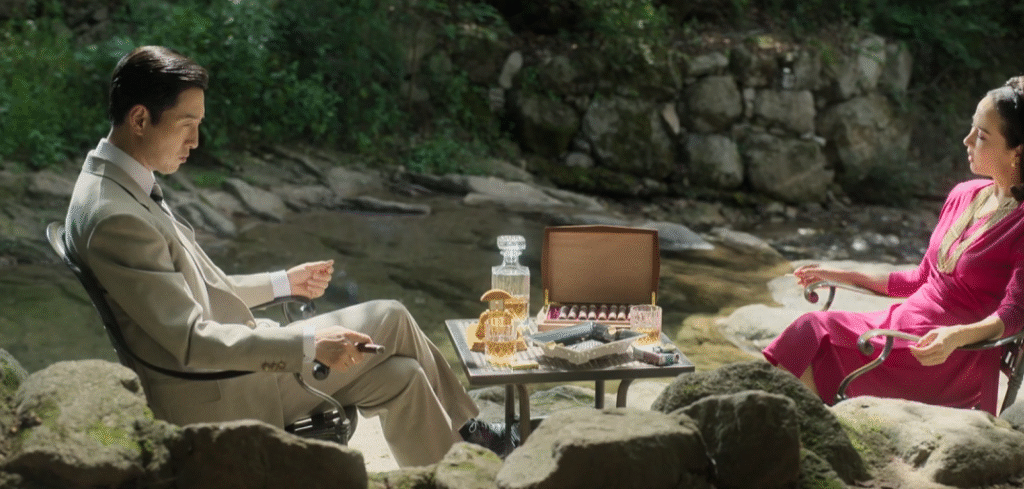
These episodes finally reveal Jang Geon-young’s (Jung Woo-sung) backstory.
His obsession with drugs is rooted in childhood trauma: a father addicted to meth and the collapse of his family. The motivation is emotionally convincing.
The issue lies in his present-day positioning.
Time and again, Geon-young arrives just too late—missing critical evidence, failing to prevent Hwang’s death, reduced to watching events unfold. This sense of powerlessness may be intentional, but repetition breeds frustration.
His restrained delivery and minimalistic expressions will also divide audiences. While his conviction is clear, he currently functions more as a witness to tragedy than a force capable of altering it.


Overall Assessment — The Clear Winner So Far : Baek Ki-tae
By the end of Made in Korea Episodes 3-4, Baek Ki-tae stands as the undisputed victor.
Hwang Guk-pyeong is gone. The Japanese connection is secured. All that remains is negotiation with the next tier of power—Cheon Seok-jung.
Another looming variable is Baek Ki-hyun, Ki-tae’s younger brother. His status as an elite military officer suggests he may become a significant fracture point in the narrative ahead.
Made in Korea is not groundbreaking in concept, but its control over tone and power dynamics is remarkably confident.
Yet its unflinching commitment to 1970s noir—power, crime, ambition—gives it undeniable pull. It remains very much a “quietly addictive” Disney Plus drama.
The series releases every Wednesday at 5 PM (KST), shifting to one episode per week starting January.
For viewers drawn to period dramas and noir storytelling, this is a series well worth the investment.

Official Streaming & Verified Resources
Made in Korea — Official Disney+ Page
https://www.disneyplus.com/
Hyun Bin
https://www.vastenm.com/theme/vaste/02/artists01_view.php?type=top&no=2
Woo Sung Jung
https://www.instagram.com/tojws/#
Related Reviews from Go K Wave
Made in Korea Powerful Episodes 1–2 │ Ambition Ignites
https://gokwv.com/made-in-korea-review-episodes-1-2/
Cashero Review │ The Ultimate Look at Its Ending & What Comes Next
https://gokwv.com/cashero-review-ending/